GRAACE HOTEL
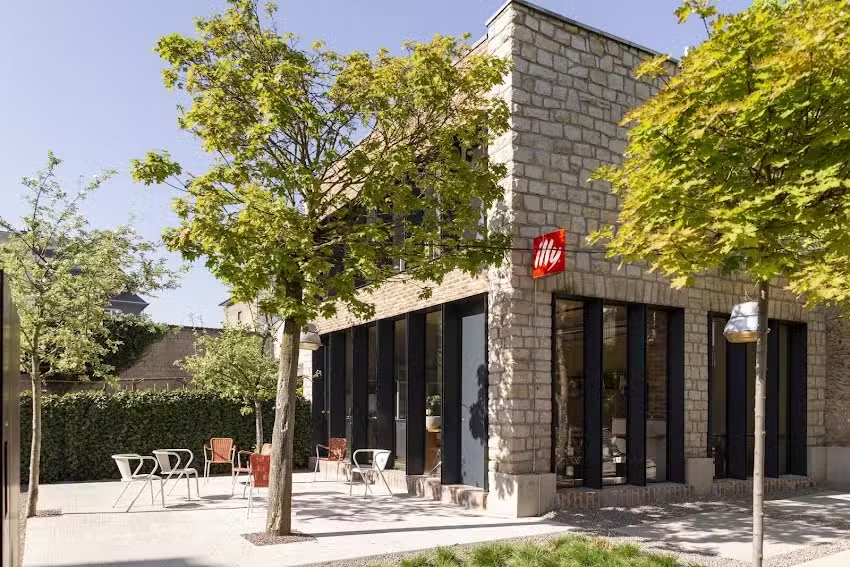
BackLocated in the Bouneweg-Süd district of Luxembourg City, the GRAACE HOTEL presents itself as an accommodation option that radically breaks with convention. Built on the site of a former metal workshop belonging to the Graas brothers, dating back to 1953, this establishment aims to offer a unique experience focused on design, minimalism, and sustainability. The hotel deliberately preserves the original walls and steel structure as reminders of its industrial past, creating a raw and authentic aesthetic. This concept, while appealing on paper, elicits mixed reactions, making this hotel an option that leaves no one indifferent.
A Strong Architectural Concept and an Eco-responsible Philosophy
The project, led by entrepreneur Steve Krack and the architecture firm CBA, transformed a former industrial site into a complex of 28 modular rooms. The central idea is to create an adventure for guests, immersing them in a unique atmosphere where noble, locally sourced materials (concrete, wood, glass) coexist with the steel of the old factory. The hotel emphasizes its commitment to sustainability, using reclaimed and recycled materials from the site and embracing a "less is more" approach. This vision translates into an ambiance described as "zen" and a "haven of peace" by some guests, who appreciate the tranquility and refined design. Controlling room functions (lighting, temperature) via an iPad is a welcome modern touch that enhances the minimalist experience.
This conceptual approach clearly distinguishes it from other hotels in the city. It's not a resort with a multitude of services, nor is it a typical vacation rental apartment . The GRAACE HOTEL positions itself more as a kind of urban guesthouse with a sharp design, aimed at a specific clientele interested in architecture and a form of digital detox.
The Rooms: Between Minimalist Cocoon and Functional Constraints
The heart of the debate surrounding the GRAACE HOTEL lies in the design of its rooms . Presented as "cocoons," they are conceived as minimalist and inviting wooden boxes. Proponents of this concept praise the originality, the comfort of the bedding, and the clever layout for such a small space. The atmosphere is described as cozy and unique, ideal for a relaxing getaway.
However, this vision has met with fierce criticism regarding its practical aspects. Several customers report major functional problems that seriously detract from the experience. The main point of contention is the bathroom design. The shower, extremely narrow (approximately 30 cm), forces users to open the doors onto the hallway to wash, flooding the space and blocking all passage. The drain is even located in the hallway, a rather perplexing configuration. The sink, the size of a standard toilet hand basin, is considered too small and poorly positioned.
The other major criticism concerns the overall lack of space. With a room width estimated at approximately 2.10 meters, the bed (140 cm) is pushed against a wall, leaving only a narrow passage on one side. This configuration is considered very impractical. This type of compact accommodation may be suitable for a short solo stay, but proves difficult for two people or a longer stay.
Equipment and Services: The Minimalism Approach
The minimalist approach of the GRAACE HOTEL extends to its amenities, a point that has sparked considerable debate. The hotel deliberately chooses not to offer televisions, mini-fridges, hairdryers, bathrobes, or wardrobes (replaced instead by a few wall hooks). While the intention is to encourage guests to disconnect and remain true to the minimalist concept, this lack of basic amenities is perceived by many as unacceptable for a hotel claiming to be four stars. For many travelers, these items are not luxuries but necessities, and their absence is a major drawback, transforming what is intended to be a boutique hotel into an experience more akin to a hostel or a luxury albergue .
In contrast, breakfast is unanimously praised as "fabulous." The emphasis on local, high-quality products seems to be a real highlight, adding a very positive note to the stay. The staff is also described as welcoming, which contributes to an overall pleasant experience despite the structural shortcomings. The property also features a patio, providing an outdoor space for relaxation.
Pricing and Target Audience: A Niche Positioning
The question of value for money is central. Some customers have reported a surprising pricing policy, where direct booking was more expensive than booking through an online platform—an unusual business practice. Furthermore, additional fees, such as those for pets, can be perceived as high relative to the space and services provided. The concept, while compelling, is interpreted by some as a way to maximize profitability by creating a large number of very small rooms at the expense of comfort.
The GRAACE HOTEL is not a place to stay that will appeal to everyone. It caters to a niche audience: travelers, often alone or as couples on very short trips, who are passionate about design, architecture, and sustainable concepts. These guests are willing to sacrifice traditional amenities (space, television, storage) for an extraordinary aesthetic and sensory experience. It is absolutely unsuitable for families, business travelers needing a functional workspace, or anyone expecting the standards of a classic four-star hotel . It is not comparable to private villas , spacious chalets , or even a functional apartment . It is a bold and uncompromising proposition, whose success depends entirely on the alignment between its philosophy and the expectations of its guests.